Soldagen: In the Interval
Luke Parkhurst, Michaella Tafalla · Afterform
Open the live design canvas to inspect every prompt, variation and decision.
Open canvasJury comments
Cira Oller Tovar: The first submission to reference the region’s vernacular architecture. A strong conceptual connection to the local context, complemented by a great aesthetic sensibility. Oliver Thomas: A strong response to the brief, with a really strong design, from the overall concept to the details and visuals. Thea Jiang: Clear design process, with final board images that thoughtfully address materiality, atmosphere, and temporal narrative while remaining well integrated with the design concept.
In conversation
“Rather than treating the engine as a final-stage tool for producing finished images, we wanted to test it as an active and collaborative part of the design process.”
Tell us about yourself, and what brings you to competitions like this.
We are Luke and Michaella, London-based architects working across architecture and visualisation, with a shared fascination for storytelling. For Gendo48, we brought together our experience in architectural design, computational workflows and visual communication, combining our different perspectives to develop the project collaboratively from concept through to final presentation.
What did you design, and what were you trying to communicate?
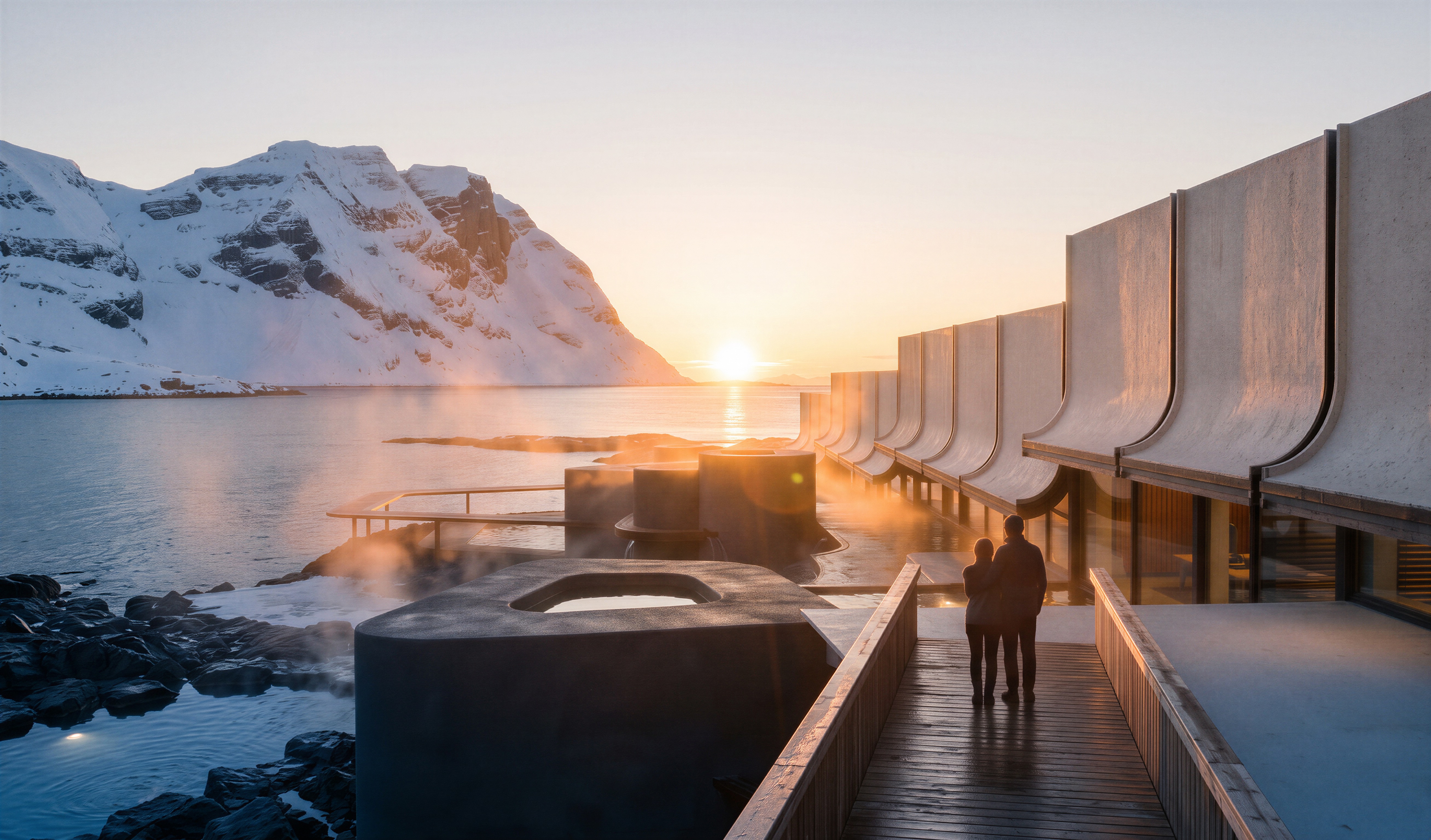
Upon reading the brief, our immediate response centred on the ephemeral nature of Soldagen — the anticipation of an event that, once experienced, is fleeting. This led us to interpret the brief through the relationship between the body and its environment across the seasons. Rather than focusing solely on the exposure to light, our attention shifted towards how the surrounding context experiences and responds to this phenomenon. From here, the idea developed around the interplay between body, perception and time — exploring how our experience of a place is continually shaped by the changing conditions around us.
Rather than treating the bathhouse as a static object, the architecture mediates changing conditions of light, temperature, exposure and landscape throughout the day and across the seasons. Cascading pools gradually cool as they extend towards the sea, while the building becomes more open to the water and more protected against the mountain. Through framed views, shifting light, material transitions and changing degrees of enclosure, the project creates a sequence of climatic experiences that unfold over time — moving between warmth and cold, shelter and exposure, anticipation and encounter.
How did you approach the timeframe, and where did Gendo fit into the process?
Given the short timeframe, we had to rethink how we could develop and test our ideas iteratively. The final deliverables were an important part of our storytelling, so we wanted both the board and the workflow behind it to contribute to that narrative.
We had previously used AI agents to critique our designs, but for this entry our focus shifted towards using the engine to actively evaluate and analyse our thinking. Drawing on the contextual research we had generated, we established a clear set of hypotheses around light, temperature, perception, and the relationship between mountain and sea. These principles then became the basis for developing and testing the form of the building.
Gendo became part of this feedback loop, allowing us to rapidly test atmosphere, materiality, and environmental conditions as the design evolved. Rather than treating the engine as a final-stage tool for producing finished images, we wanted to test it as an active and collaborative part of the design process — helping us evaluate ideas, identify what was working, and refine the proposal within the limited timeframe.
How has your relationship with Gendo developed?
This was our first time using Gendo, and one of its biggest advantages was the ability to work collaboratively within the same space as the visual production. We were particularly interested in the inquisitive nature of the Gendo Assistant: we could introduce an idea, receive questions in response, and use those prompts to reconsider and develop our thinking. The process became less linear and more conversational, with each exchange opening up new possibilities to explore.
The speed of the workflow was equally valuable. We could move quickly from one idea to the next and immediately see how different interpretations might affect the design. The editing tools allowed us to evaluate each iteration without losing sight of the underlying idea, making it easier to explore alternative expressions of the same concept.
This was essential within such a short competition timeframe. Rather than spending hours developing an idea only to discover that it was not working, we could challenge and reassess decisions almost immediately. Gendo therefore became more than a tool for producing the final image; it became part of the design process itself — creating a dynamic workspace in which our ideas could be tested, discussed and refined collectively, helping us move towards a shared vision.
What does the recognition mean to you, and what would you do differently next time?
We have been interested in how AI can become a more inquisitive part of the design process — not simply as a means of producing an image, but as a way for designers to question, explore and develop speculative ideas. The opportunity to work with a platform that allowed us to explore this further was particularly exciting, and this competition gave us a chance to put that approach into practice.
One aspect we would have liked to explore further is how Gendo could support design at different scales. Our usual process tends to move from the macro to the micro: establishing the larger spatial and formal ideas first, then gradually resolving the detail. It would have been interesting to test broader spatial ideas alongside smaller moments, details and material conditions much earlier in the process.
Being shortlisted was already incredibly exciting, and ultimately receiving first place gave us an opportunity to reflect on where we could take this way of working next. The recognition means a great deal to us, particularly because we were drawn to the way the competition was structured and its emphasis on the process of exploration.
Working with Gendo as an active part of the design process helped us discover possibilities we had not initially anticipated, and left us excited to see where this way of working could take us next.
Next
HØYDE