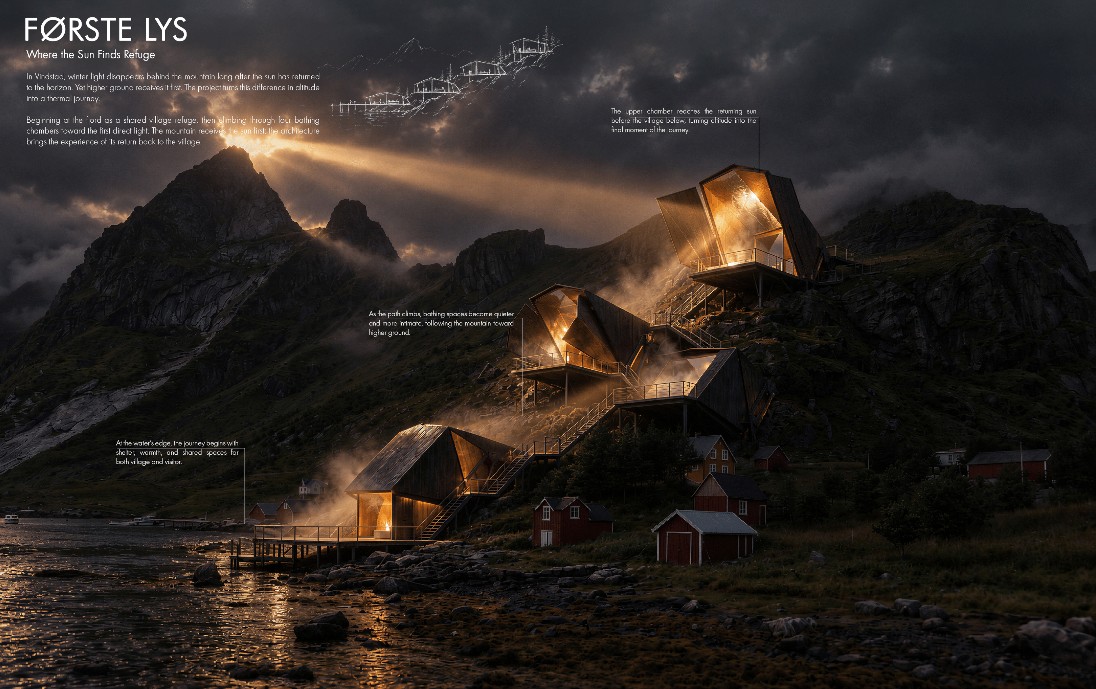
Første lys
AbdelRahman Hassan el-Khashab, Soad M. Shahin · 5th Dimension
Open the live design canvas to inspect every prompt, variation and decision.
Open canvasIn conversation
“Gendo gave us a shared visual language that allowed us to communicate ideas, review iterations, and maintain our workflow despite not being physically together.”
Tell us about yourself, and what brings you to competitions like this.
We are AbdelRahman and Soad, two multidisciplinary design architects passionate about innovative, human-centred design, based in Cairo. We work for different companies in two different countries, on iconic, commercial and residential hospitality projects.
What did you design, and what were you trying to communicate?
Første lys is conceived as more than a seasonal wellness destination; it becomes a new social and architectural focal point for the lakeside community, strengthening the relationship between the settlement, the landscape, and the returning sun. Rather than functioning as a single-purpose spa, the project is designed as an adaptable, multi-use public structure capable of supporting activity throughout the year, creating a continuous destination for both residents and visitors and contributing to the revitalisation of the local economy.
How did you approach the timeframe, and where did Gendo fit into the process?
For Første lys, we approached the challenge by establishing a strong architectural narrative first and then developing the project through rapid cycles of spatial, environmental, and visual testing. Our starting point was the idea of the returning sun and its relationship with the Norwegian landscape, using this as a driver for the building's orientation, stepped massing, thermal sequence, and relationship with the surrounding terrain.
Within the limited timeframe, we worked collaboratively to test different configurations and quickly evaluate how each iteration supported the concept. Rather than treating visualisation as a final presentation step, we used it as part of the design process itself — testing materiality, atmosphere, seasonal conditions, daylight, spatial relationships, and architectural expression as the project evolved.
Gendo became an important part of this workflow. We used it to rapidly translate our ideas into visual studies, allowing us to compare alternatives and make design decisions much faster. It helped us move between conceptual sketches, model-like studies, atmospheric explorations, and realistic architectural imagery without breaking the continuity of the process.
It was also particularly valuable because we were working across a distance. Gendo gave us a shared visual language that allowed us to communicate ideas, review iterations, and maintain our workflow despite not being physically together. This made the process more collaborative and responsive, especially under the pressure of a short timeframe.
Ultimately, our approach was to let the concept, architecture, landscape, and visualisation develop together — with Gendo acting not simply as a rendering tool, but as an active part of our design thinking and collaboration throughout Første lys.
How has your relationship with Gendo developed?
It's not our first time using it — we used it in the first competition — and there's a big upgrade from the first time.
What does the recognition mean to you, and what would you do differently next time?
This recognition meant a lot to us because it was a validation not only of the final project, but of the idea, process, and collaboration behind Første lys. We developed the project within a demanding timeframe and across a physical distance, so seeing the work recognised gave us confidence that the concept of using architecture to capture and share the returning sunlight could communicate beyond the project itself. It also reinforced our belief that strong architectural storytelling can connect place, culture, climate, and human experience into one coherent design.
If we were to do it again, we would give ourselves more time to develop the technical and architectural resolution of the project. The short timeframe pushed us toward rapid conceptual and visual iteration, which was valuable, but with more time we would explore the structural system, material detailing, environmental performance, and the relationship between the building and the existing landscape in greater depth. We would keep the same spirit of experimentation and collaboration, but push the project further from a strong conceptual proposal toward a more fully resolved architectural reality.
Previous
Midnight Sons
Next
The Water Opens the Way