Q&A with Ismail Seleit: Bringing the Studio's DNA into Gendo

Joe Sherman · Head of Growth at Gendo
8 October 2026
"What differentiates one studio from another is their taste and their ability to apply it. That's the DNA we want to bring into Gendo."
Ismail and I first met a year ago, over dinner at a French restaurant in Paris. A lot has changed since then, in AI and at Gendo. So I sat down with our co-founder for a quick catch-up on where AI in architecture stands right now, what we've just shipped, what the team is building next, and where you can catch him in the coming months.
AI right now
Joe: What's been the biggest shift in AI for architecture and design in the last few weeks?
Ismail: There's been a real leap in computer use and 3D modelling. Honestly, I thought this would be cracked earlier. When I started three years ago, my first thought was that BIM would be solved quickly: AI could churn through the information, and you wouldn't need BIM models or BIM managers in the same way.
It turned out to be a much harder problem. Precision modelling means understanding the basics of physics and dimensions. Until a few weeks ago, the best you could get from an image was what I call "dead geometry": a simple mesh you couldn't edit, reuse or get accurate information out of, and it wasn't dimensionally correct. With the latest models, that now seems to have been cracked. It started with Astra, and now everyone is catching up.
Joe: How are practices actually using Gendo day to day right now?
Ismail: What's interesting is that practices use it throughout the design process. It doesn't sit in one place; they keep coming back to it.
Architecture software has usually been linear. You start with a sketch, move to Rhino for the concept study, take it into Revit for documentation, then send it to visualisers who render in V-Ray or whatever they use. Gendo fits into all of those stages. In a way it's a new type of software, and it's been refreshing to see people use it like that.
Joe: What's the one thing people still get wrong about AI in design?
Ismail: It's not always about realism. And the fact that it hallucinates is a feature, not a bug.
We sometimes get carried away with control, wanting it to produce exactly what's in our heads. But the power usually comes when you give it some space. Models are now multimodal by nature, trained on images, text and video together, so they're more grounded in reality and have more physical understanding. If you try to control every detail, you lose their ability to suggest things you hadn't thought of.
What we're working on
Joe: We've just launched Custom Style and Custom Catalogue. What problems do they solve, and how do they work for a practice?
Ismail: "Custom" is the theme. As models become more intelligent, we risk everything starting to look the same. However smart a model gets, it has its own taste, and if everyone uses the same one, everyone's work drifts the same way. We're working hard to make it easy for studios to bring their own stuff into the model.
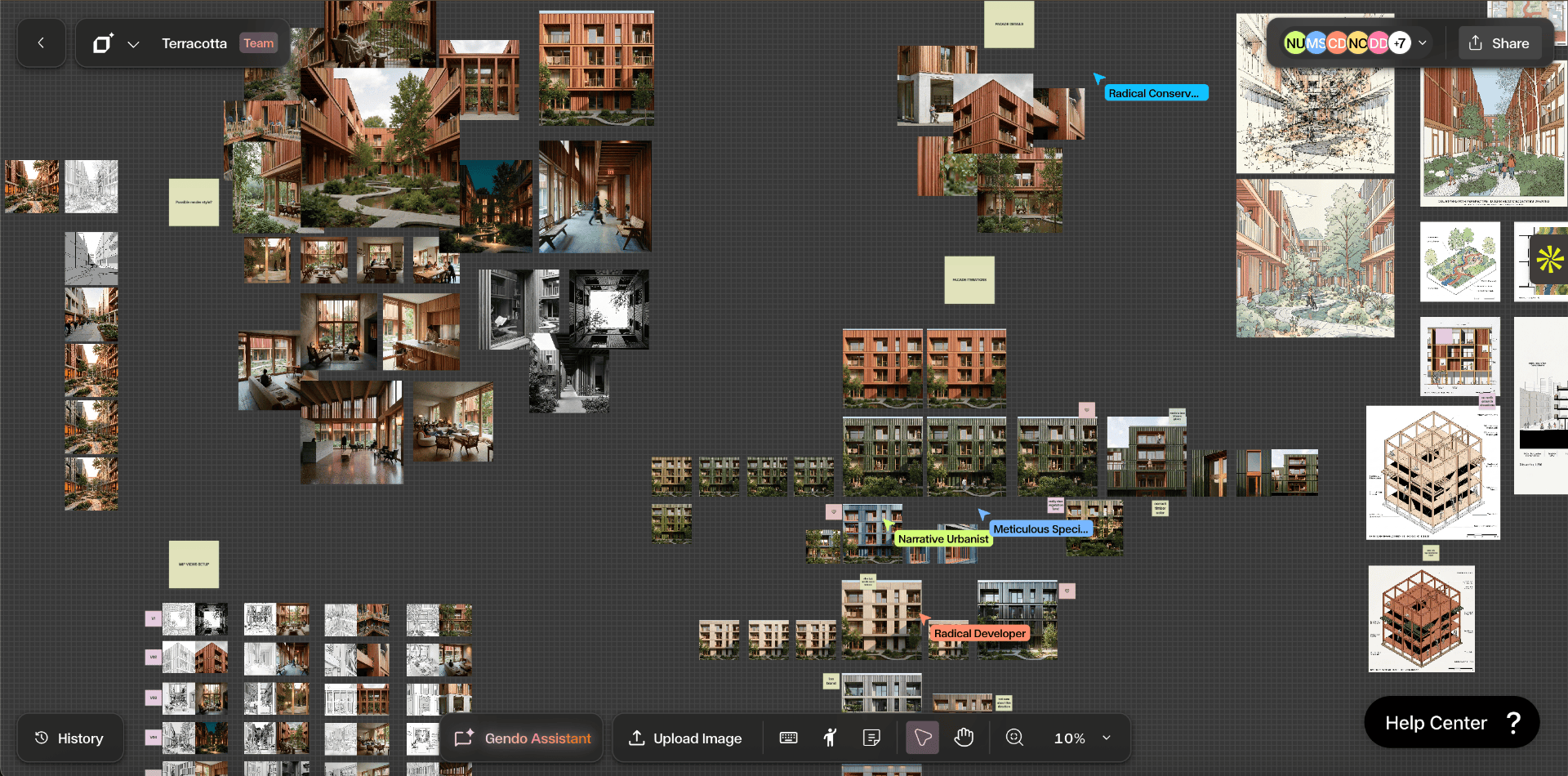
Custom Style is the first step. It picks up the style you feed it and applies it to your designs as intelligently as possible, tuning the model towards your own biases rather than generic output.
Custom Catalogue sits under the same umbrella. What differentiates one studio from another is their taste and their ability to apply it. Having your own materials catalogue inside Gendo is part of that studio DNA.
Custom Catalogue came straight from customer feedback. Since partnering with Material Bank, we've seen how much designers value working with real materials. It moves concepts from basic to concrete, helps projects progress through stages faster, and makes sharing with clients easier. Studios then told us they wanted their own catalogue, always to hand, rather than dragging and dropping images each time. So we built it, and it's available now.
Joe: What's the team focused on building right now?
Ismail: We're constantly looking at the latest models, and there are more and more of them. But we don't ride the hype cycles.
Take the current hype: giving a model an image and having it build a 3D model for you. It looks like magic. But at Gendo we step back and ask what's valuable for architects in their daily work. No architect finalises an image and then starts modelling from it. That isn't where design begins.
So we rigorously test everything that comes out to see how it fits practical architectural workflows. Alongside that, we're expanding the idea of studio DNA. It comes through styles and catalogues, but also through memory: Gendo remembering how you work as you use it, from text information to images.
Over the last couple of weeks, we've also spoken to hundreds of customers about how 3D in Gendo would actually fit their work. We're excited to reveal something soon that's built for everyday use, not novelty.
Where to see Ismail
Joe: Where can people see you next?
Ismail: Paris is next. It's where Joe and I first met, and where an eternal friendship began.
You can catch Ismail at these upcoming events (the full diary is on our Events page):
- RIBA Stirling Prize 2026, 15 October, Old Billingsgate, London: come and say hello if you're there.
- Paris, November: Ismail will be there with the Gendo team.
- RIBA AI in Practice Summit, 3 February 2027: Ismail and George will talk on *Architecture: AI for the quiet majority*. The session covers Gendo's belief that AI should work for every practice, not just the biggest studios.
Thanks to Ismail for taking the time. More Q&As with the team are coming soon. To read how Ismail came to Gendo, see From Foster + Partners to Gendo.